Choosing between a retractable and fixed awning is rarely a question of which option is objectively better. It is a question of how you intend to live with your outdoor space, and that matters far more than any spec sheet. Both styles have earned their place in British homes for good reason, and the right answer for your property usually depends on a handful of practical considerations: how often you sit outside, what kind of weather your garden faces, and whether you value the flexibility to choose when shade goes up or whether you want a covered area that is always ready.
This guide walks through the differences between retractable vs fixed awnings, the real-world pros and cons of each, what they tend to cost, and how to settle on the right option for your home. By the end you should have a clear sense of which direction suits your property, your routine, and your budget.
Retractable vs Fixed Awnings at a Glance
Before getting into the detail, here is a quick summary of how the two styles compare on the questions homeowners ask most often. A retractable awning extends and retracts on demand, offering flexible sun and rain cover when deployed, with manual or motorised operation and the option of wind and rain sensors. It should be retracted in high winds, sits tucked away when closed, and is generally the lower upfront investment for like-for-like coverage. A fixed awning is a permanent structure that stays in position year-round, providing continuous cover without controls, built to handle weather without supervision, with a consistent architectural presence and a higher upfront cost depending on build.
Each of those points is a real trade-off, and the right balance varies from one home to the next. The sections below take each comparison further.
What is a Retractable Awning?
A retractable awning is a wall-mounted shading system that extends out over a patio, terrace or seating area when you want shelter, and folds back against the house when you do not. The fabric runs on a frame of folding arms that hold tension as the awning extends, so the canopy stays taut even at full reach. When retracted, the unit sits in a slim cassette or open frame above the door or window, largely out of view.
Modern systems are usually motorised. A discreet handset opens and closes the awning at the press of a button, and many homeowners specify wind and rain sensors that retract the canopy automatically when the weather turns. Manual crank-handle versions are still available and remain reliable for smaller spans. For homes that need genuine shelter from showers as well as sun, waterproof retractable awnings use heavier-grade fabrics and tighter pitch settings to allow rainwater to run off cleanly.
What is a Fixed Awning?
A fixed awning is a permanent shading structure that stays in position year-round. Most use a rigid frame with either a fabric canopy or a solid roof such as polycarbonate or glass, and they are engineered to withstand wind, rain and seasonal loading without being moved. The result is a piece of garden architecture rather than a piece of equipment, and that often shapes how families end up using the space.
Fixed designs sit at the more substantial end of the residential awnings market and overlap with verandas, glass rooms and louvered roofs. Where a retractable awning is a practical accessory, a fixed structure is closer to an extension of the home, creating a defined outdoor room that can be used in almost any weather. They are particularly common over patio awnings and dining areas where year-round coverage matters more than flexibility.
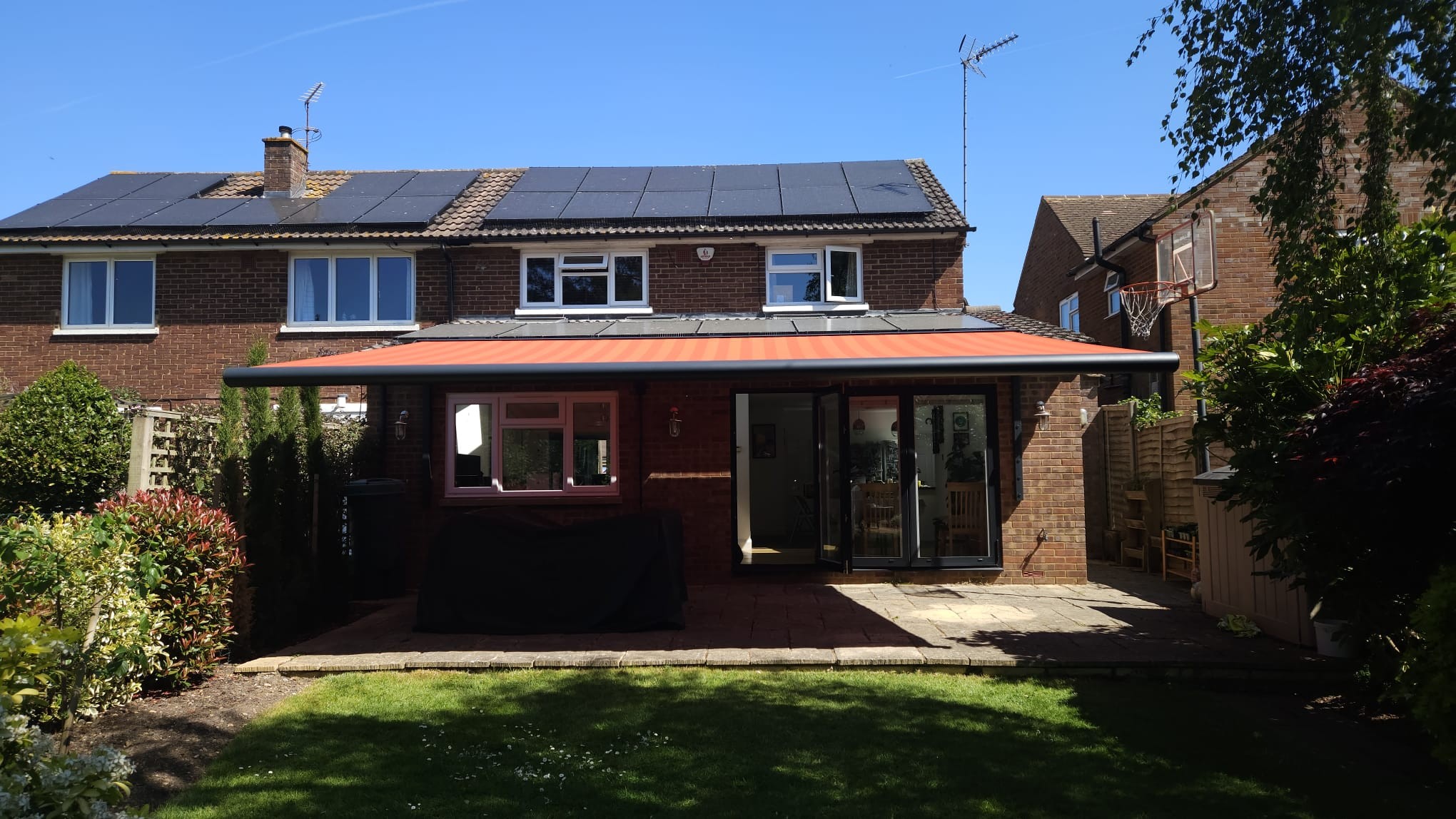
The Difference Between Retractable and Fixed Awnings
Advantages of Retractable Awnings
The headline benefit is control. You decide when the canopy is out and when the patio sits open to the sky. That matters in a country where the weather can shift in a single afternoon, and it means the same outdoor space can be a sun-shaded lunch spot at one o’clock and an open star-watching area at nine. Because the fabric is only exposed when you choose to extend it, the canopy tends to last considerably longer than the same fabric on a permanently extended structure.
Motorisation makes the whole system effortless to operate, sensors take the decision out of your hands when you are not at home, and the slim cassette profile keeps the awning close to invisible from the garden when retracted. For homes where the rear elevation matters architecturally, that low visual impact is a meaningful benefit.
Limitations of Retractable Awnings
Retractable awnings are not designed to remain extended in strong winds, so on very blustery days the canopy needs to come in. They also do not provide cover unless you choose to deploy them, which sounds obvious but matters if you want a permanently usable outdoor space that you can step into without a thought. Standard retractable fabrics shed light rain reliably, but only the proper waterproof systems are specified for sustained downpours.
Advantages of Fixed Awnings
The biggest gain is consistency. The canopy is always there, so the patio is always usable, whether that means stepping out with a coffee in February or hosting a Sunday lunch in the rain. Glass-roofed and louvered structures take this further, creating a near-room-quality space that can stretch the British summer by months either side. Because the frame is engineered to stay put, fixed structures handle wind and weather without supervision, which makes them a good fit for properties left empty during the day.
For some homeowners, the architectural presence is itself a benefit. A well-specified veranda or fixed canopy adds character to the rear of the house in a way a retractable cassette cannot, and tends to read as a permanent improvement to the property. Where the layout does not allow a wall-mounted structure, free standing awnings achieve a similar result without needing to attach to the building.
Limitations of Fixed Awnings
The trade-offs mirror the retractable benefits. You do not have the option to put the canopy away on a perfect summer evening, the upfront cost is generally higher, and fixed structures take up a permanent share of the rear elevation. Some properties also need planning consideration for larger fixed builds, particularly where they project significantly into the garden or sit close to a boundary.
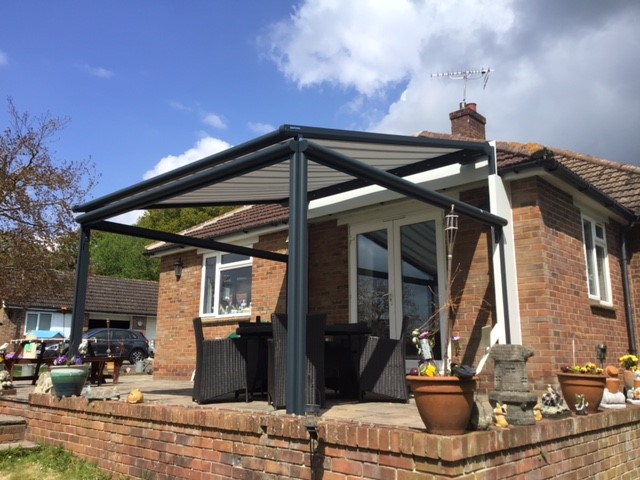
Which is Better for the British Climate?
Both styles are designed for UK conditions, and Regal Awnings specifies them with that in mind. The honest answer is that they handle weather differently rather than one being objectively superior.
A retractable awning protects you from strong sunshine on warm days, light to moderate rain when set with the correct pitch, and the worst of summer glare. When the weather turns properly nasty, you simply retract it. That cycle of use is part of why the canopy fabric tends to outlast its fixed equivalents, because it spends most of its life folded away from UV light.
A fixed structure faces the weather every day and is engineered to handle that. Glass verandas, louvered roofs and traditional fixed fabric awnings all sit in this category, with progressively more weatherproofing as you move along the spectrum. Homeowners across regions with mixed weather patterns, from coastal Sussex and Hampshire to the more sheltered gardens covered by Awnings in Essex, tend to choose between the two based on how much they want to use the space when it is actively raining.
Cost Difference Between Retractable Awnings vs Fixed Awnings
For comparable coverage, a retractable awning is usually the lower upfront investment, particularly with manual operation. Adding motorisation, full waterproof fabric specification and integrated wind and rain sensors brings the price up, and a high-end retractable system with all the features can rival a modest fixed structure.
Fixed awnings span a wider price range because they cover everything from a basic fabric canopy to a glass room with louvered ventilation. Materials, frame engineering and the size of the installation all influence the figure, and most of the cost difference between fixed and retractable comes down to the structure itself rather than the fabric.
Both are made-to-measure when supplied by Regal Awnings, so an accurate price comes from a site survey rather than a brochure. Interest-free finance is available on residential orders, which often shifts the question from upfront affordability to which option actually suits the home.
How to Choose Between Retractable Awnings vs Fixed Awnings?
A few practical questions tend to settle the decision quickly.
- How often do you actually want the space covered?
- If the answer is some of the time, in good weather, retractable is usually the right call. If the answer is whenever I want to use it, including when it is raining, a fixed structure earns its keep.
- How important is the look of the rear elevation when nothing is in use?
- A retractable cassette is close to invisible. A fixed structure is, by design, always part of the view.
- How exposed is the garden?
- Properties on hilltops, near the coast or with limited shelter will rule out leaving a retractable system extended for long periods, which makes fixed structures more attractive for owners who want the space ready to use without monitoring the forecast.
- Are you considering motorisation?
- Many homeowners weighing this question also explore whether automation is worth the additional spend. Our Are Electric Awnings Worth It? guide takes that question on directly.
For most homes, the right answer is the one that fits the way the family already uses the garden, rather than the way they imagine they might. A short conversation with a surveyor who can see the property tends to reach a clearer answer than any guide can. Book a personalised consultation with Regal Awnings and a surveyor will visit your home, look at the rear elevation, talk through how you use the garden, and recommend the option that genuinely fits, with a made-to-measure specification and a tailored quote.
Retractable vs Fixed Awnings FAQs
Are retractable awnings worth it in the UK?
For most British homes, yes. Retractable awnings provide flexible sun and light rain protection, retract neatly out of the way when not needed, and extend the usable hours of a patio considerably from late spring through to early autumn. With waterproof fabric and sensor controls specified, they can also handle showers without intervention. The investment is usually recouped over years of additional outdoor use.
Can a fixed awning stay up all year?
Yes. Fixed awnings, glass verandas and louvered roof systems are engineered to remain in place year-round, including through winter. They are built to handle wind and rainfall without being adjusted, which is one of their core advantages over retractable systems. Routine cleaning and occasional servicing keep the structure performing well, and most homeowners find them low-maintenance once installed.
Which lasts longer, a retractable or fixed awning?
Both can last decades when properly specified and installed. Retractable awning fabric often shows a longer lifespan than fixed canopy fabric because it spends most of its life folded away from UV exposure. Fixed structures with glass or louvered roofs tend to outlast either fabric option, since the roofing materials themselves are far more durable than woven canopy fabric.
Do retractable awnings work in the rain?
Standard retractable awnings shed light rain when extended at the correct pitch. For genuine rain protection, waterproof retractable systems use heavier-grade fabrics and tighter pitch angles that channel water off cleanly. Most homeowners who want to use the space in active rainfall specify a waterproof model. Wind and rain sensors can be added to retract the canopy automatically if the weather worsens.
Is a retractable or fixed awning better for a small garden?
Retractable awnings tend to suit smaller gardens better because they do not visually intrude when not in use. The cassette sits flush against the house and the rear of the property reads as open. Fixed structures can work in compact gardens, but they need to be specified carefully so they do not overwhelm the space or block sightlines from the house.
Will I need planning permission for an awning?
Most domestic awnings, retractable or fixed, fall under permitted development and do not require planning permission. Larger fixed structures, those close to a boundary, or installations on listed buildings may need approval. Regal Awnings will flag this during the site survey and advise based on the property and the proposed installation.